


 English
 русский
 Español
 عربى
عربى Português
Zhongchi
Zhongchi
Zhongchi
Zhongchi
Zhongchi
Zhongchi
Zhongchi
Zhongchi
Zhongchi
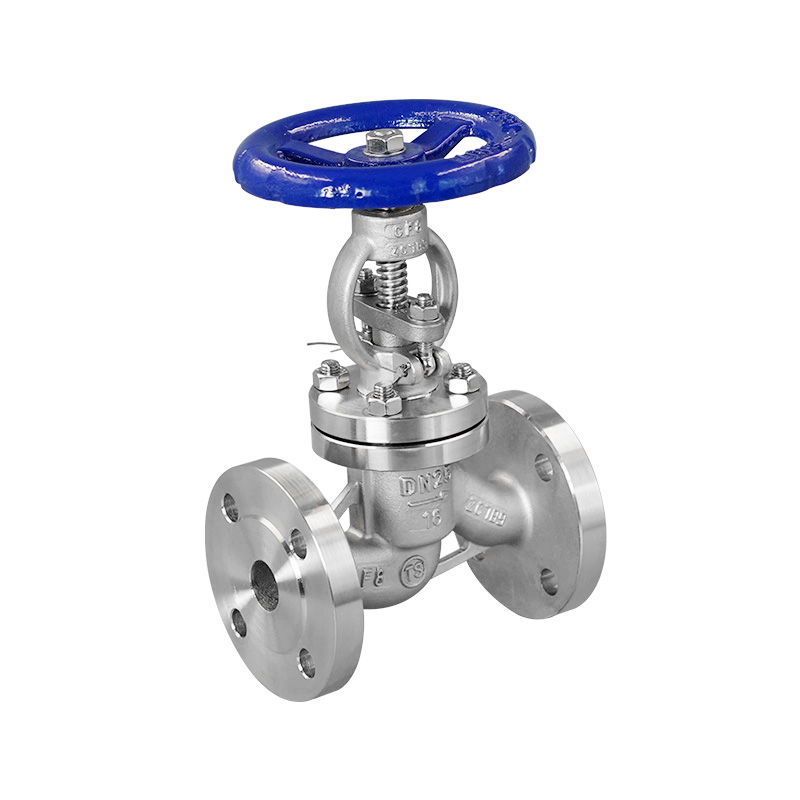
Users of large-bore globe valves in everyday applications frequently report a particular issue: when these valves are used with media subject to significant pressure differentials—such as steam or high-pressure water—they are often difficult to close. No matter how much force is applied, leakage is invariably observed, making it difficult to achieve a tight seal. This problem stems from the valve’s structural design and the fact that the maximum torque a person can exert is insufficient.
Analysis of the Causes of Difficulty in Operating Large-Bore Valves
The maximum horizontal force an average adult can exert ranges from 60 to 90 kg, depending on individual physical condition.
Standard globe valves are designed with a flow path from low to high. When closing the valve, the operator applies horizontal force to turn the handwheel, causing the disc to move downwards to achieve closure. At this point, the operator must overcome a combination of three forces, namely:
1) Axial thrust Fa;
2) Friction force Fb between the packing and the valve stem;
3) Contact friction between the valve stem and the valve disc core Fc
The total torque is ∑M = (Fa + Fb + Fc)R
It can be seen that the larger the nominal diameter, the greater the axial thrust. When the valve is nearly closed, the axial thrust approaches the actual pressure of the pipeline network (since during closure, P1 – P2 ≈ P1, and P2 = 0)
For example, a DN200 globe valve used on a 10 bar steam pipe has an axial thrust force Fa for closing alone of 10 × πr² = 3140 kg. The horizontal circumferential force required for closing is already close to the limit of what a normal human can exert, so it is extremely difficult for a single person to fully close this valve under such operating conditions.
Of course, some plants recommend installing such valves in reverse to resolve the difficulty in closing them, but this then leads to the problem of difficulty in opening the valve once closed.
Analysis of the causes of internal leakage in large-bore globe valves
Large-bore globe valves are generally used at locations such as boiler outlets, main steam distribution cylinders and main steam pipes, where the following issues exist:
1) The pressure differential at boiler outlets is generally high, resulting in higher steam flow velocities and greater erosion and damage to the sealing surfaces. Furthermore, as boiler combustion efficiency cannot be 100%, the steam at the boiler outlet contains a high moisture content, which can easily cause cavitation and erosion damage to the valve sealing surfaces.
2) For globe valves located near boiler outlets and steam distributors, the steam emerging directly from the boiler exhibits intermittent superheating. During the process of saturation, if the boiler water softening treatment is inadequate, acidic or alkaline substances may precipitate, causing corrosion and erosion of the sealing surfaces; furthermore, certain crystalline substances may adhere to and crystallise on the valve sealing surfaces, preventing the valve from achieving a tight seal.
3) For valves at the inlet and outlet of steam distributors, the steam demand downstream of the valve fluctuates significantly due to production requirements and other factors. Under conditions of substantial changes in flow velocity, phenomena such as flash evaporation and cavitation are likely to occur, thereby causing erosion and cavitation damage to the valve seat.
4) When opening large-diameter pipelines, it is generally necessary to preheat the pipeline. The preheating process typically requires a very low flow rate of steam to allow the pipeline to be heated slowly and evenly to a certain temperature before the globe valve can be fully opened. This prevents rapid temperature rise in the pipeline, which could cause excessive expansion and damage to certain connection points. However, during this process, the valve opening is often very small, resulting in an erosion rate far greater than that experienced during normal operation, which significantly reduces the service life of the valve’s sealing surfaces.
Solutions for Difficulty in Opening and Closing Large-Diameter Globe Valves
1) Firstly, it is recommended to select a bellows-sealed globe valve, which avoids the frictional resistance associated with piston valves and packing valves, making operation easier.
2) The valve plug and seat must be made of materials with excellent erosion and wear resistance, such as Stellite cemented carbide.
3) A double-disc valve design is recommended to prevent excessive erosion caused by small opening angles, which can affect service life and sealing performance.