


 English
 русский
 Español
 عربى
عربى Português
Zhongchi
Zhongchi
Zhongchi
Zhongchi
Zhongchi
Zhongchi
Zhongchi
Zhongchi
Zhongchi
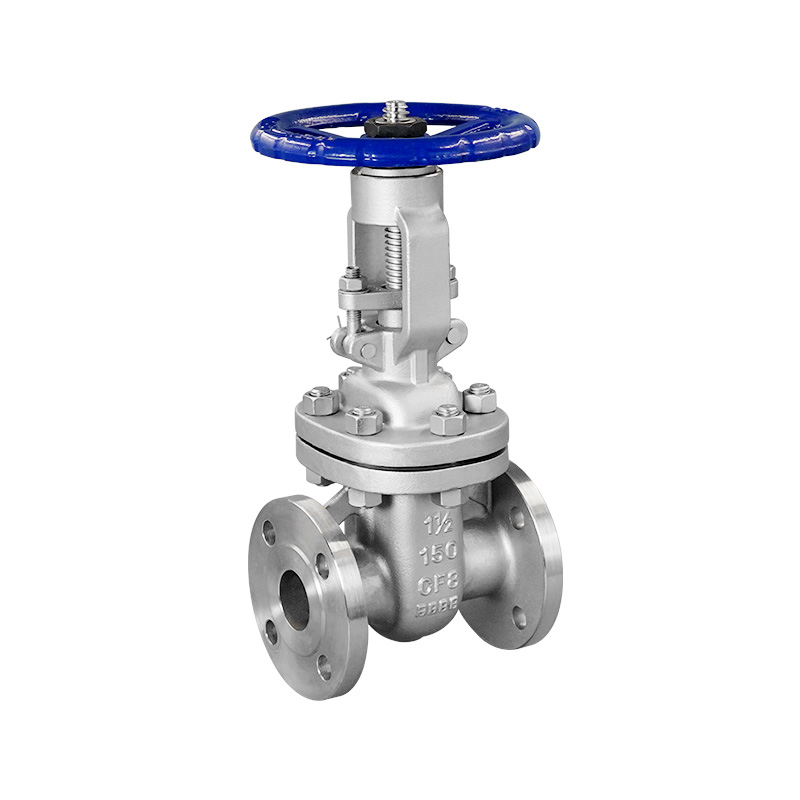
What is the function and operating principle of a gate valve?
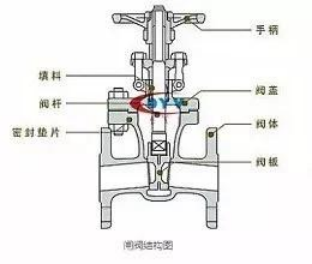
1. Gate valves are classified as open-type and closed-type gate valves. The direction of movement of a gate valve is perpendicular to the direction of fluid flow. Gate valves can only be fully opened or closed; they cannot be used for regulation or throttling.
2. The gate has two sealing surfaces. In the most common type of gate valve, these two sealing surfaces form a wedge, the angle of which varies according to the valve’s specifications. Wedge-type gate valves can be manufactured with a solid gate, known as a rigid gate, or with a gate that allows for slight deformation, known as a flexible gate.
3. Depending on the gate structure, gate valves can be classified as wedge-type or parallel-type. Wedge-type gates come in three structures: single-gate, double-gate and elastic-gate. Based on structure, they can be classified as flat-gate valves and knife-gate valves.
4. The operating principle of a manually operated gate valve involves the rotation of the handwheel, which drives the threaded connection between the handwheel and the valve stem. This action raises the gate connected to the valve stem, thereby opening or closing the valve.
What are the advantages of gate valves?
1. Low flow resistance. As the flow path within the valve body is longitudinal, the medium does not change direction as it passes through the valve, resulting in low flow resistance.
2. Low operating torque, requiring minimal effort to open and close. As the gate valve opens and closes, its movement is perpendicular to the direction of the medium’s flow. Compared to globe valves, gate valves require less effort to operate.
3. The medium can flow in any direction from either side of the gate valve without restriction, disturbance or pressure drop. It is more suitable for pipelines where the direction of medium flow may change.
4. Short overall length. As the gate valve is positioned vertically within the valve body and the gate is positioned horizontally, its overall length is shorter than that of a globe valve.
5. Good sealing performance, with minimal erosion of the sealing surfaces when fully open.
6. When the valve is fully open, erosion of the sealing surfaces by the working medium is less than that of a globe valve.
7. Simple design, good forgeability, and wide range of applications.